
Choosing a VPS is not only about CPU, RAM, or storage. For a website or application serving people in Nepal, the physical location of the server can affect network latency, user experience, support, billing, data location, and how easily you can scale to international markets.
That is why the choice between Nepal VPS hosting vs international VPS deserves more thought than simply comparing the specifications on two pricing pages.
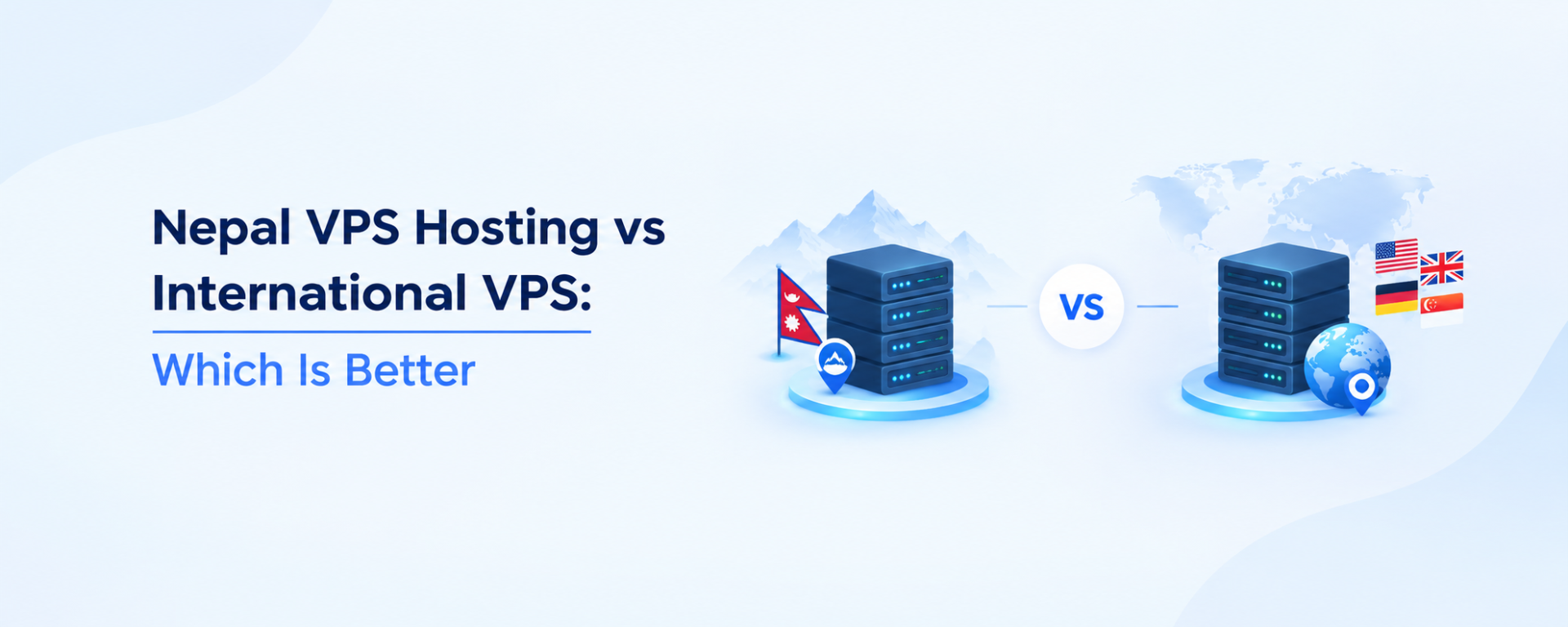
A Nepal VPS usually means your virtual server is hosted in a data center inside Nepal, commonly in Kathmandu. An international VPS means the server is hosted outside Nepal, such as in India, Singapore, Europe, or North America. Neither option is automatically better. The right choice depends mainly on where your users are and what your application needs.
Quick Answer: Which VPS Is Better?
If most of your visitors or application users are in Nepal, a Nepal-based VPS is often the better starting point because a nearby server can reduce network latency and keep the origin close to your audience.
If your users are spread across several countries, an international VPS may be more practical, especially when the provider offers multiple data center regions and lets you choose a location close to your main market.
For businesses serving both Nepal and international users, the decision becomes more specific. A nearby international location such as India or Singapore can sometimes provide a useful middle ground, while a CDN can help deliver cached static content closer to visitors around the world.
The important point is this: choose the server location based on your audience, not simply on the label “Nepal” or “international.”
Nepal VPS Hosting vs International VPS: What Is the Difference?
The VPS technology itself is not fundamentally different. In both cases, you are renting a virtual server with allocated resources such as CPU, RAM, storage, an operating system, and an IP address.
The main difference is where that virtual server is physically hosted and how network traffic reaches it.
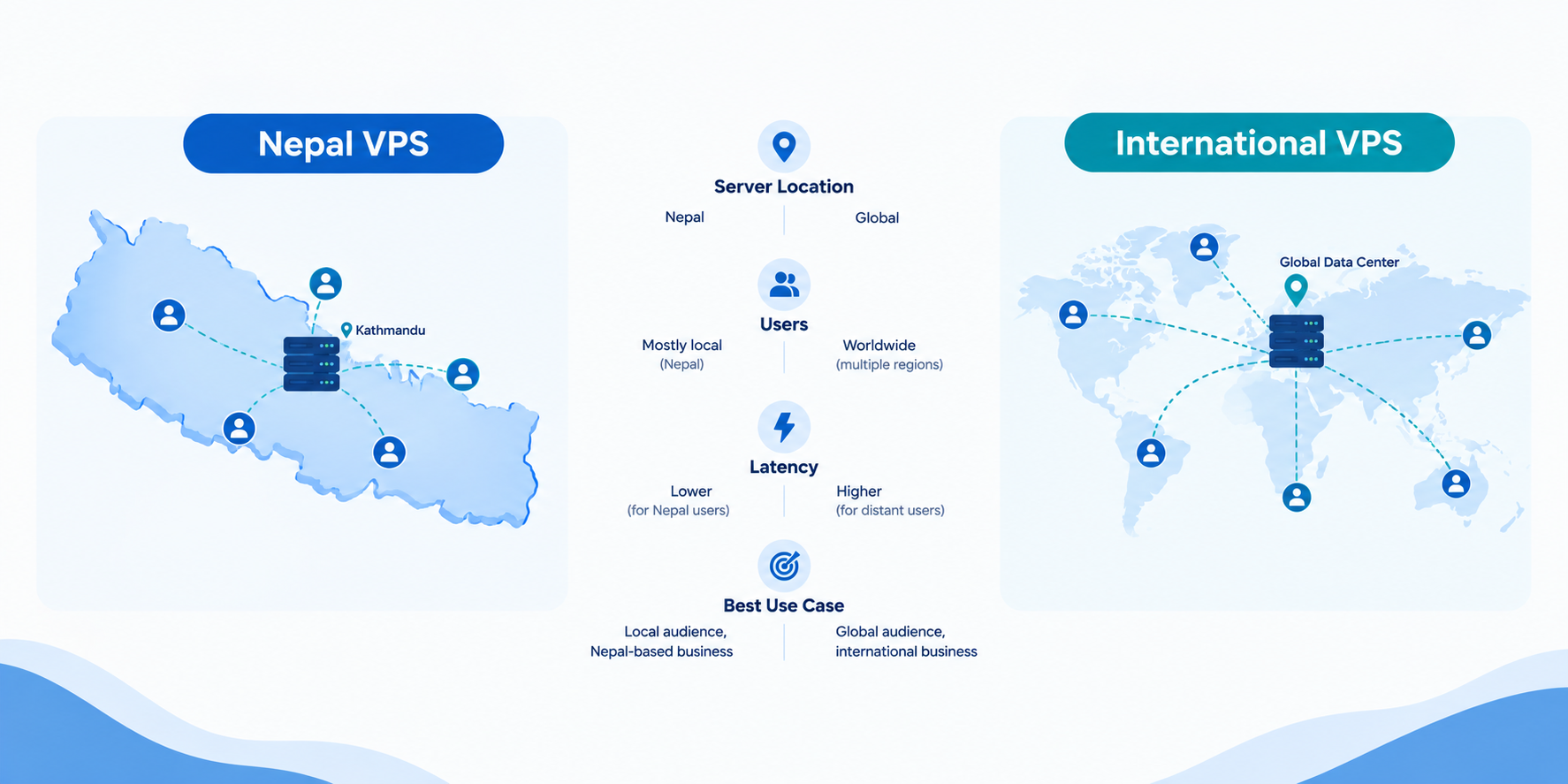
| Factor | Nepal VPS | International VPS |
|---|---|---|
| Server location | Data center inside Nepal | Data center outside Nepal |
| Nepal user latency | Usually the strongest advantage | Depends heavily on the selected region and network route |
| International reach | Can be less convenient for distant audiences | More location choices for international audiences |
| Local support | May offer Nepal-based support | Support depends on the provider and service |
| Local billing | Some providers support NPR and local payment methods | Often billed in USD or another foreign currency |
| Data location | Data can remain within Nepal if the provider confirms this | Data is stored in the selected foreign region |
| Data center choices | Usually fewer locations | Often many locations across regions |
| Scaling across countries | May require migration to another region | Often easier when multiple regions are available |
| Best fit | Nepal-focused websites and applications | International or multi-region workloads |
These are general characteristics, not guarantees. Two providers can offer very different network quality, hardware, support, and pricing even when their servers are in the same country.
Server Location and Latency
Latency is the time required for data to travel between two points on a network. Physical distance is one of the important factors, although routing, network equipment, congestion, and the quality of the provider’s network also matter.
For a website serving mainly Nepali visitors, placing the origin server closer to those visitors can reduce the distance that requests need to travel.
This becomes especially relevant for applications that make many back-and-forth requests. Examples include dashboards, APIs, database-driven applications, remote administration tools, and real-time services.
An international server is not necessarily slow for Nepal. A VPS in a nearby Asian region can perform very well. The important question is not whether the server is international, but how far away it is and how traffic is routed between the user and the data center.
Performance Is More Than CPU and RAM
It is easy to compare two VPS plans and choose the one with more CPU or RAM. That is only part of the picture.
A website’s performance can also be affected by:
- CPU generation and performance
- RAM capacity
- Storage technology and I/O performance
- Network capacity
- Network routing
- Server location
- Virtualization technology
- Web server configuration
- Database performance
- Application code
- Caching and CDN configuration
A VPS with better specifications can still provide a worse experience for a particular audience if its network path is significantly less suitable.
At the same time, a nearby VPS cannot compensate for an inefficient application. Moving a poorly optimized website from one country to another will not automatically solve database queries, large images, excessive JavaScript, or application-level bottlenecks.
For that reason, treat location as one part of your performance strategy rather than the entire strategy.
Local Users vs Global Users
Your audience should be the first major factor in the decision.
Choose a Nepal VPS when most users are in Nepal
A Nepal-based VPS can make sense for:
- Nepali business websites
- Local news portals
- Nepal-focused ecommerce stores
- Internal business applications used in Nepal
- Local SaaS applications
- Government or institutional applications where local infrastructure matters
- Development and testing environments used primarily from Nepal
If almost all traffic comes from Nepal, placing the origin in or near Nepal can be a straightforward way to keep the server close to the people using it.
Choose an international VPS when users are outside Nepal
An international VPS can be a better fit when your main audience is in another country or spread across several regions.
For example, an application targeting users in Europe may benefit more from a European data center than a Nepal-based server. Similarly, an application targeting users across Asia may benefit from an Asian data center with strong connectivity to the countries it serves.
International providers can also offer more choices when you need to move the server closer to a new market.
What If Your Users Are Both in Nepal and Abroad?
This is where the decision becomes more interesting.
Suppose a Nepal-based company has customers in Nepal, India, Australia, and the United States. A server in Kathmandu may be excellent for one part of the audience but less optimal for users on other continents.
A server in a nearby international region may provide a more balanced option. Another approach is to keep the application origin in one region and use a CDN for static content.
A CDN, or content delivery network, stores eligible content at edge locations closer to users. This can reduce the distance that cached files such as images, CSS, JavaScript, and other static assets need to travel.
However, a CDN does not magically move your database or application server next to every visitor. Dynamic requests still depend on the origin architecture, so server location continues to matter for applications with significant server-side processing.
Pricing and Value
Price comparisons can be misleading when comparing Nepal-based VPS hosting plans with international VPS plans.
Do not compare only the monthly headline price. Check what is actually included.
Look at:
- vCPU allocation
- RAM
- NVMe or SSD storage
- Bandwidth policy
- IPv4 availability
- Backup options
- Snapshot support
- DDoS protection
- Root access
- Operating system choices
- Control panel availability
- Managed or unmanaged support
- Data center location
- Billing currency
A cheaper VPS is not necessarily cheaper after you add backups, control panel licenses, management, or other services that your application requires.
For Nepal-based businesses, billing convenience can also matter. Some local providers support NPR billing and local payment methods, while international providers may require foreign currency payment methods. The practical value of that difference depends on your business and accounting process.
Support Can Be a Major Difference
Server problems do not always happen during convenient hours.
When comparing providers, look at the support model rather than assuming that every VPS includes the same level of assistance.
A local provider may be useful if you prefer communication with a team operating in Nepal, local billing, or support that understands common local connectivity and hosting requirements.
International providers can offer highly capable infrastructure and documentation, but the support experience varies considerably from one company to another. Some VPS services are unmanaged, meaning you are responsible for operating system updates, security, configuration, backups, and application troubleshooting.
Before purchasing, find out exactly what “support” means. Does it cover the network and hardware only, or will the provider help with server configuration and application-level problems too?
Data Location and Compliance
Where your server is physically located can matter for businesses with data residency, contractual, regulatory, or internal security requirements.
A Nepal-based VPS may be preferable when a project requires data to remain inside Nepal, but you should not assume that a server labeled “Nepal VPS” automatically satisfies a legal or regulatory requirement.
Check the provider’s actual data center location, backup locations, data handling practices, and applicable terms before making a compliance decision.
For international VPS hosting, the same principle applies. Choosing a server in Germany, Singapore, India, or the United States means you should understand where primary data and backups are stored and what legal or contractual requirements apply to that environment.
For regulated workloads, get confirmation from the provider and your legal or compliance team rather than relying on a marketing page.
VPS for Developers and Web Applications
For developers, the decision is also influenced by the workload.
A basic WordPress website and a custom API may both run on a VPS, but their networking and resource requirements can be very different.
If you are deploying a Django, Node.js, Laravel, FastAPI, or other custom application, consider:
- Where your users are located
- Where your database is located
- Whether your application makes frequent database requests
- Whether you need WebSockets or long-running processes
- Whether you need a specific operating system
- Whether you need root access
- Whether you need Docker or custom services
- Whether you need background workers or scheduled jobs
- Whether you plan to add more servers later
For example, putting an application server in one region and its database in a distant region can introduce additional network latency between application requests and database queries. Keeping tightly connected components in the same or nearby infrastructure can be important for application performance.
If you are moving from shared hosting to a VPS because of a custom application, first identify which server-level requirements forced the upgrade. That will help you choose the right location and VPS configuration instead of simply buying the largest plan available.
When a Nepal VPS Is the Better Choice
A Nepal VPS is usually worth considering when most of these statements are true:
- Most users are located in Nepal.
- Your application needs a server close to Nepali users.
- Local billing is useful for your business.
- Nepal-based support is important to you.
- You prefer infrastructure physically located in Nepal.
- Your application does not need multiple international regions.
- Your database and other important services will also be close to the application server.
This can be a practical option for local businesses, Nepal-focused ecommerce platforms, news websites, internal systems, and locally targeted applications.
When an International VPS Is the Better Choice
An international VPS is usually worth considering when:
- Your primary users are outside Nepal.
- Your customers are distributed across multiple countries.
- You need several data center regions.
- You want to deploy closer to a specific international market.
- Your project depends on a broader cloud or infrastructure ecosystem.
- You expect your infrastructure to expand beyond Nepal.
You do not have to choose a server in North America or Europe simply because it is an international VPS. For a Nepal-focused application, a nearby international location can be much more sensible than a distant one.
Common Mistakes When Choosing VPS Location
Choosing the lowest price without checking location
A cheap VPS can become an expensive choice if the network location is poor for your users or if you later need to migrate.
Assuming every international VPS is slow for Nepal
International does not mean distant. India and other nearby Asian regions can be reasonable choices for Nepal-focused applications depending on routing and provider quality.
Assuming a Nepal VPS is automatically faster in every situation
A local server can be a strong choice for local users, but performance still depends on hardware, network quality, application design, and server configuration.
Ignoring the database location
If your application server is close to your users but the database is on another continent, frequent database requests can still introduce noticeable delays.
Treating a CDN as a complete replacement for good server placement
A CDN can improve delivery of cached content, but dynamic requests still need to reach the origin. The origin server’s location remains important for many applications.
Comparing only advertised specifications
Two VPS plans with the same CPU and RAM can perform differently. Look at the full infrastructure, network, storage, backups, support, and location.
Frequently Asked Questions
Is Nepal VPS hosting faster than international VPS hosting?
For users in Nepal, a well-connected Nepal-based VPS can have a latency advantage because the server is physically closer. But an international VPS in a nearby region can also perform well. Actual routing and provider network quality matter.
Is international VPS hosting good for a website targeting Nepal?
Yes. An international VPS can be a good option if the chosen data center has suitable connectivity to Nepal. Test latency from your target network before committing to a long-term plan.
Which is better for a Nepali business website?
If the website mainly serves Nepali visitors, a Nepal VPS is worth considering. If the business serves customers across several countries, compare local infrastructure with nearby Asian and other international regions.
Can I use a CDN with a Nepal VPS?
Yes. A CDN can cache eligible content at edge locations and reduce the distance static content travels to users. It does not eliminate the need to choose an appropriate origin location for dynamic requests.
Should my database be on the same VPS?
Not always. Small applications may run the application and database on the same server for simplicity. Larger systems may separate them. Whatever architecture you choose, consider the network distance between the application and database because frequent database communication can be latency-sensitive.
Does server location affect SEO?
Server location can influence performance and latency, which can affect user experience. However, hosting location is only one part of website performance and is not a substitute for good technical SEO, caching, image optimization, and a well-built website.
Can I move from a Nepal VPS to an international VPS later?
Usually, VPS workloads can be migrated, but the exact process depends on the provider, operating system, application, storage, DNS, and data size. Before purchasing, check whether the provider offers snapshots, backups, or migration assistance.
Conclusion
The choice between Nepal VPS hosting vs international VPS is really a choice about audience, infrastructure, and future requirements.
A Nepal VPS can be a strong option when your users are mainly in Nepal and you value a nearby server, local support, local billing, or infrastructure within Nepal. An International VPS can make more sense when your users are spread across countries, you need more data center choices, or your application is targeting an international market.
There is also a middle ground. A nearby international data center can provide a useful balance for some Nepal-based projects, while a CDN can improve the delivery of cached content to users in other regions.
Before choosing, compare the actual server location, network latency, resources, storage, backups, support, billing, data location, and migration options. The best VPS is not necessarily the one with the biggest specifications. It is the one whose infrastructure matches where your application and users actually are.