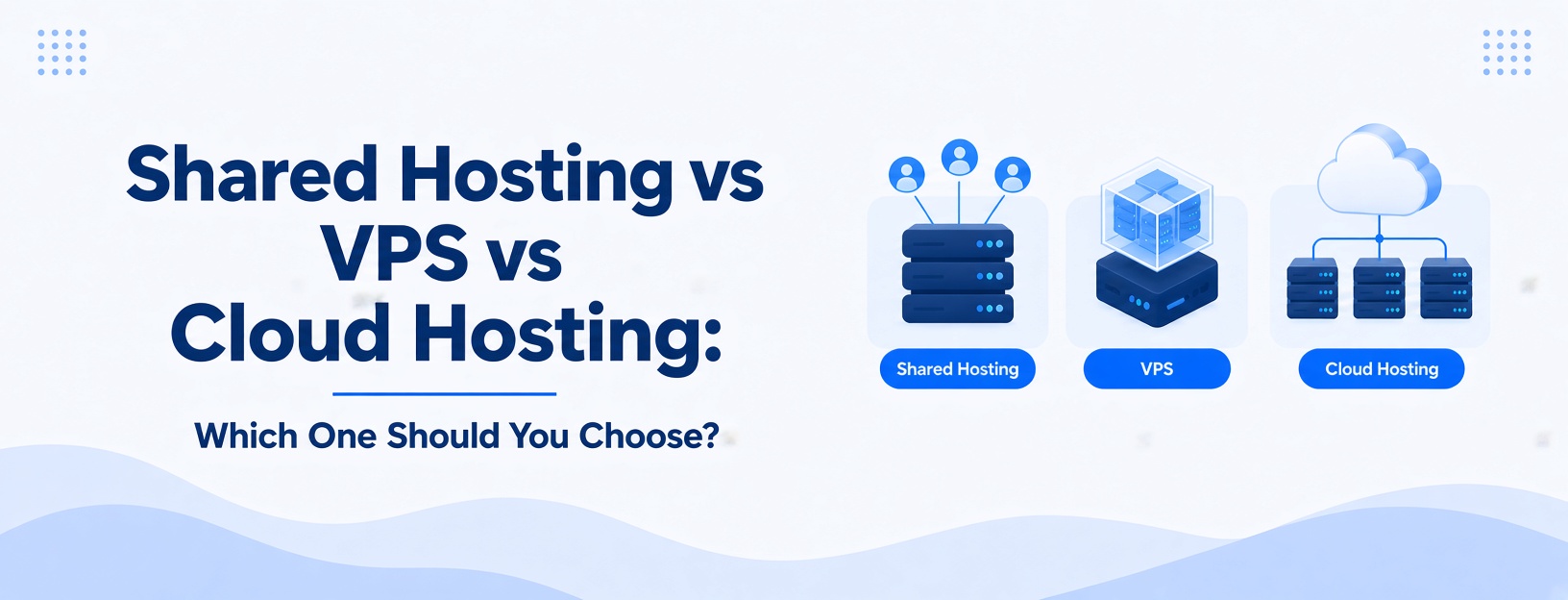

Choosing the right hosting can be confusing when every option promises better performance, reliability, or scalability. For a small website, shared hosting may be all you need. A growing application may need the control of a VPS, while a business with changing infrastructure requirements may benefit from cloud hosting.
The important question isn’t which hosting type is the most powerful, but which one fits your website’s actual requirements.
Your traffic, application requirements, resource needs, budget, technical knowledge, and preferred level of server management should all influence the decision.
In this guide, we’ll compare shared hosting vs VPS vs cloud hosting based on cost, control, performance, scalability, management, and use cases so you can choose the right option without paying for resources you don’t need.
Quick answer: Which Hosting Type Is Best for Your Website?
For most small and simple websites, shared hosting is the easiest and most affordable starting point.
Choose VPS hosting when you need more control, dedicated resource allocations, or a custom server environment.
Choose cloud hosting when your application benefits from cloud infrastructure, flexible resource configurations, or a hosting environment designed for changing requirements.
There is no universally best option. The right choice depends on what your website actually needs.
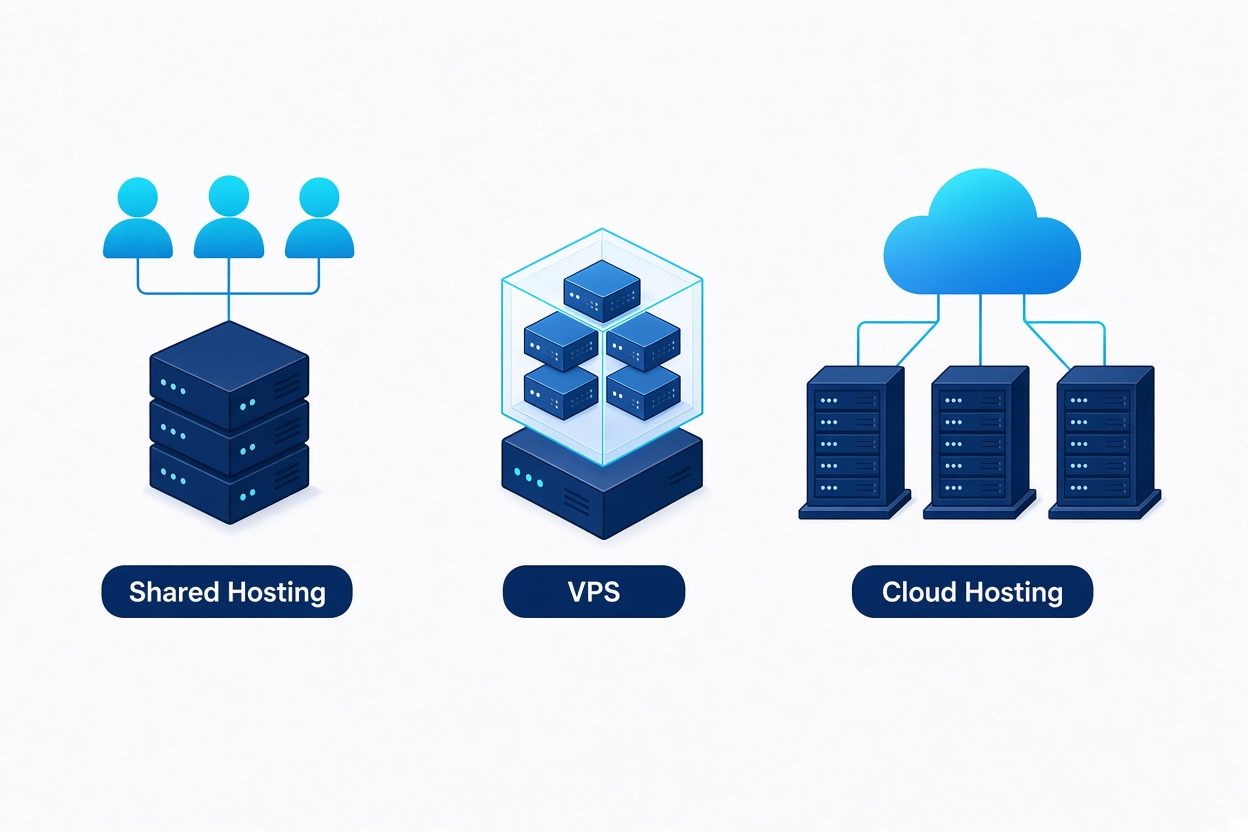
Shared Hosting vs VPS vs Cloud Hosting: The Ultimate Comparison
Before looking at each option in detail, here is the simplest comparison:
| Factor | Shared Hosting | VPS Hosting | Cloud Hosting |
|---|---|---|---|
| Cost | Low | Medium to High | Medium to High |
| Ease of use | Very easy | Moderate to High | Easy to Moderate |
| Server control | Limited | High | Moderate |
| Resource isolation | Limited | Stronger isolation | Depends on architecture |
| Performance | Suitable for smaller workloads | More consistent resource availability | Depends on infrastructure and plan |
| Scalability | Limited | Usually requires upgrading resources | Depends on the provider and plan |
| Technical knowledge | Low | Moderate to High | Low to Moderate |
| Server management | Mostly handled by provider | Managed or customer-managed | Depends on provider |
| Best for | Blogs, portfolios, small websites | Growing websites, custom applications and performance-focused websites | Websites and applications needing flexible cloud infrastructure |
One important point: these categories can overlap.
For example, a VPS can run on cloud infrastructure. In that case, VPS describes the virtual server environment, while cloud describes aspects of the underlying infrastructure.
So don’t choose a plan simply because the word cloud sounds more advanced. Compare the actual resources, architecture, management options, limits, and pricing.
Shared Hosting: Best for Simple Websites
Shared hosting is a good choice when you want an affordable and easy-to-manage hosting solution.
Multiple websites use resources from the same server environment, while the hosting provider handles most of the underlying server maintenance. You typically manage your website through a control panel rather than managing the server itself.
Best for:
- Personal blogs and portfolios
- Small business websites
- Company websites
- Low to moderate traffic websites
- Beginners who don’t want to manage a server
The main advantage is simplicity. You can focus on your website while the provider takes care of much of the server infrastructure.
The trade-off is less control and fewer resources compared with a VPS. If your website regularly reaches resource limits or needs custom server configurations, it may be time to consider an upgrade.
VPS Hosting: More Control and Dedicated Resources
VPS hosting is a better fit when your website needs more control, resources, or flexibility than shared hosting can provide.
A VPS provides an isolated virtual server environment where you have greater control over the operating system, software, and server configuration.
Best for:
- Growing business websites
- E-commerce websites
- Web applications
- APIs and custom applications
- Websites requiring more predictable resources
- Developers who need server-level control
The biggest advantage of a VPS is control. Depending on the hosting setup, you can install software, configure services, and customize the server according to your application’s requirements.
The trade-off is that VPS hosting generally requires more technical knowledge, especially when using an unmanaged VPS. A managed VPS can reduce the amount of server administration you need to handle.
Cloud Hosting: Best for Flexibility and Scalability
Cloud hosting uses cloud-based infrastructure to host websites and applications. It can provide flexibility in how computing resources are allocated and managed, making it suitable for different types of workloads.
Unlike traditional hosting that may rely on a single physical server, cloud hosting can use resources from interconnected servers and infrastructure. However, the exact architecture, resource allocation, and management options vary between providers.
Best for:
- Growing online businesses
- SaaS applications
- E-commerce platforms
- Websites with changing traffic
- Applications that need flexible resources
- Projects expecting rapid growth
Cloud hosting can be offered with fixed resources or flexible resource options, depending on the provider and plan. Therefore, don’t assume that every cloud hosting plan automatically scales or works in the same way.
Before choosing one, check the available CPU, RAM, storage, bandwidth, resource limits, and how upgrades or additional resources are handled.
Shared Hosting vs VPS vs Cloud: Which Should You Choose?
The right option depends mainly on your website’s current requirements.
Choose Shared Hosting If
- You are starting a small website.
- Your traffic is relatively low or predictable.
- You want simple management.
- You don’t need root access or custom server software.
- Keeping hosting costs low is important.
For a typical blog, portfolio, or small business website, shared hosting can provide everything you need without the additional complexity of server administration. If shared hosting fits your requirements, you can explore our available shared hosting plans.
Choose VPS Hosting If
- Your website has outgrown shared hosting.
- You need more control over the server.
- Your application requires custom software or configurations.
- You need more predictable resource allocations.
- You have the technical knowledge to manage a server or prefer a managed VPS.
A VPS is particularly useful when your website is no longer a simple hosting workload and you need greater control over the environment. If that’s where your requirements are heading, you can explore our available VPS hosting plans.
Choose Cloud Hosting If
- Your application benefits from cloud-based infrastructure.
- You need a hosting environment that can accommodate different resource requirements.
- You expect your website or application to grow over time.
- You want different cloud resource configurations to choose from.
- The provider’s cloud architecture matches your application’s requirements.
Don’t choose cloud hosting simply because it sounds more advanced. Make sure its infrastructure and resource model actually solves a problem your website has. If cloud infrastructure fits your requirements, you can explore our available cloud hosting plans.
When Should You Upgrade Your Hosting?
You don’t need to move to a VPS or cloud hosting simply because your website is growing.
Look at your actual resource usage and requirements.
Consider upgrading when:
- Your website consistently reaches CPU, RAM, or other resource limits.
- Performance drops during traffic spikes.
- You need software that isn’t supported by your current hosting.
- Your application requires more server control.
- Your current plan no longer provides enough room for growth.
Before upgrading, check whether the problem can be solved through website optimization, caching, image optimization, or database improvements.
If the workload has genuinely outgrown the current hosting environment, upgrading is the more practical solution.
Don’t Choose Hosting Based on Price Alone
The cheapest hosting plan isn’t always the best value.
When comparing plans, look beyond storage and monthly price. Consider:
- CPU and RAM resources
- Storage and I/O limits
- Bandwidth
- Backup options
- Server management
- Support
- Security features
- Upgrade options
- Additional usage costs
For example, an inexpensive unmanaged VPS may cost less than managed hosting but require significantly more time and technical knowledge to maintain.
Choose based on the total cost and effort, not just the advertised price.
A slightly more expensive plan can be worthwhile if it provides the resources, management, support, and upgrade path your website actually needs.
Frequently Asked Questions
Is VPS better than shared hosting?
Not for every website. VPS hosting provides more control and resources, but shared hosting is cheaper and easier to manage. If your website doesn’t need additional control or resources, shared hosting may be the better choice.
Is cloud hosting better than VPS?
Neither is universally better. A VPS can be a good choice when you need a controlled virtual server environment, while cloud hosting can be useful when your application benefits from cloud-based infrastructure and flexible resource options.
When should I move from shared hosting to VPS?
Consider moving when you consistently reach your hosting resource limits, experience performance issues that optimization cannot solve, or need server configurations that shared hosting doesn’t support.
Is cloud hosting suitable for small websites?
It can be, but it may be unnecessary. If your website has low, predictable traffic and doesn’t require cloud-based infrastructure, shared hosting may provide everything you need at a lower cost and with less complexity.
Can I start with shared hosting and upgrade later?
Yes. Starting with shared hosting is often a practical choice for a new website. As traffic, resource requirements, or technical needs increase, you can move to a VPS or cloud-based solution.
Final Thoughts
The choice between shared hosting vs VPS vs cloud hosting comes down to your website’s actual needs.
Shared hosting is a practical choice when affordability and simple management are your priorities. VPS hosting makes more sense when you need greater control and more predictable resource allocations. Cloud hosting is worth considering when your application benefits from cloud infrastructure and flexible resource options.
You don’t need to choose the most powerful hosting available. Choose the hosting that gives your website enough resources, control, and room to grow without adding unnecessary cost or complexity.
Start with the solution that provides enough resources for your current requirements, monitor how your website performs, and upgrade when your requirements justify it.